Setup the Automation Controller ( AWX ) using Ansible
Categories:
Projects:
c2platform/ansible
,
c2platform.mw
,
c2platform.mgmt
,
ansible-execution-environment
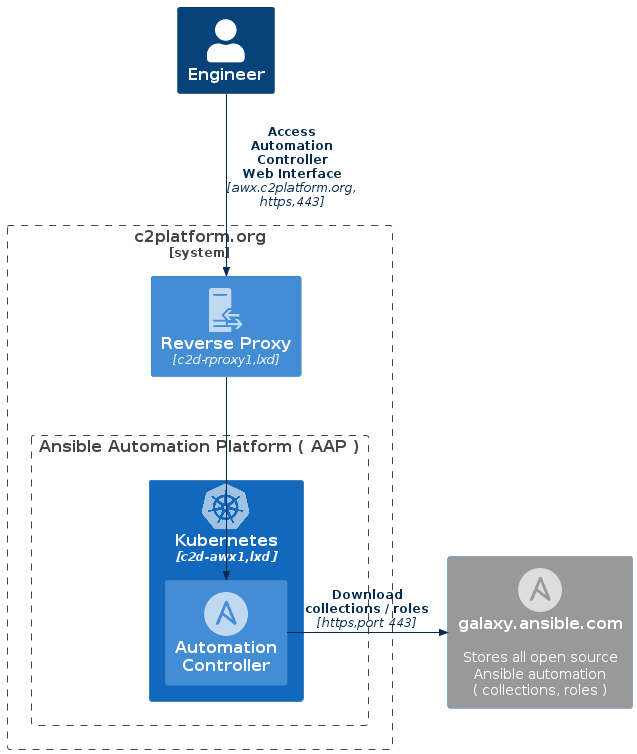
This guide provides step-by-step instructions on how to create an
AWX
instance on the c2d-awx1 node
using the AWX Operator Helm Chart
and
Ansible
. Here’s an overview of the process:
- Kubernetes Cluster Setup: Ansible takes the lead in configuring a
Kubernetes instance, leveraging the
microk8srole within thec2platform.mwcollection. - Kubernetes Configuration: With the Kubernetes cluster primed, Ansible
proceeds to configure it further, harnessing the
kubernetesrole from the samec2platform.mwcollection. - AWX Deployment: The deployment of AWX onto the Kubernetes cluster is orchestrated using the AWX Operator Helm Chart. Ansible seamlessly manages this deployment process.
- AWX Customization: To finalize the setup, the
c2platform.mgmtcollection’sawxrole is employed to tailor the AWX instance to the desired configuration.
Upon successful completion of these steps, you’ll gain access to the AWX
interface by visiting the following URL: https://awx.c2platform.org
.
Prerequisites
Create the reverse and forward proxy c2d-rproxy1.
c2
unset PLAY  # ensure all plays run
vagrant up c2d-rproxy1
For more information about the various roles that c2d-rproxy1 performs in this project:
- Setup Reverse Proxy and CA server
- Setup SOCKS proxy
- Managing Server Certificates as a Certificate Authority
- Setup DNS for Kubernetes
Setup
To create the Kubernetes instance and deploy the AWX instance, execute the following command:
vagrant up c2d-awx1
Warning!
AWX may take some time to become available, which could potentially cause Ansible to fail during step 4, AWX Customization:. If you encounter a failure, please ensure that you can access the AWX web interface. Once you see the login screen, you can re-run the provisioning process with the following command:
vagrant provision c2d-awx1
Verify
To verify your AWX instance, follow these steps:
Connect
If you have kubectl installed on your host, you can also access the cluster
using that by running the following commands:
export BOX=c2d-awx1
sudo snap install kubectl --classic
vagrant ssh $BOX -c "microk8s config" > ~/.kube/config
kubectl get all --all-namespaces
Show me
NAMESPACE            NAME                                                  READY   STATUS      RESTARTS   AGE
kube-system          pod/hostpath-provisioner-766849dd9d-jdd5b             1/1     Running     0          17m
kube-system          pod/calico-node-vf72q                                 1/1     Running     0          17m
kube-system          pod/coredns-d489fb88-8xpwb                            1/1     Running     0          17m
kube-system          pod/calico-kube-controllers-d8b9b6478-2dj4s           1/1     Running     0          17m
container-registry   pod/registry-6674bf676f-twgpz                         1/1     Running     0          17m
kube-system          pod/dashboard-metrics-scraper-64bcc67c9c-5hbvz        1/1     Running     0          15m
kube-system          pod/kubernetes-dashboard-74b66d7f9c-8hqgf             1/1     Running     0          15m
metallb-system       pod/controller-56c4696b5-w2xbs                        1/1     Running     0          15m
metallb-system       pod/speaker-pkkpk                                     1/1     Running     0          15m
cert-manager         pod/cert-manager-cainjector-7985fb445b-jdkk6          1/1     Running     0          15m
cert-manager         pod/cert-manager-655bf9748f-6jxbg                     1/1     Running     0          15m
kube-system          pod/metrics-server-6b6844c455-7564v                   1/1     Running     0          15m
cert-manager         pod/cert-manager-webhook-6dc9656f89-br48w             1/1     Running     0          15m
awx                  pod/awx-operator-controller-manager-699d64766-ltpxh   2/2     Running     0          15m
awx                  pod/awx-postgres-15-0                                 1/1     Running     0          14m
awx                  pod/awx-web-6cb68b86cc-dp8tr                          3/3     Running     0          14m
awx                  pod/awx-migration-24.4.0-cljp4                        0/1     Completed   0          13m
awx                  pod/awx-task-5c96c47f86-r7vn7                         4/4     Running     0          14m

NAMESPACE            NAME                                                      TYPE           CLUSTER-IP       EXTERNAL-IP   PORT(S)                  AGE
default              service/kubernetes                                        ClusterIP      10.152.183.1     <none>        443/TCP                  17m
container-registry   service/registry                                          NodePort       10.152.183.38    <none>        5000:32000/TCP           17m
kube-system          service/kube-dns                                          ClusterIP      10.152.183.10    <none>        53/UDP,53/TCP,9153/TCP   17m
kube-system          service/metrics-server                                    ClusterIP      10.152.183.147   <none>        443/TCP                  16m
kube-system          service/kubernetes-dashboard                              ClusterIP      10.152.183.175   <none>        443/TCP                  16m
kube-system          service/dashboard-metrics-scraper                         ClusterIP      10.152.183.61    <none>        8000/TCP                 16m
metallb-system       service/webhook-service                                   ClusterIP      10.152.183.124   <none>        443/TCP                  16m
cert-manager         service/cert-manager                                      ClusterIP      10.152.183.51    <none>        9402/TCP                 15m
cert-manager         service/cert-manager-webhook                              ClusterIP      10.152.183.177   <none>        443/TCP                  15m
kube-system          service/dashboard-lb                                      LoadBalancer   10.152.183.133   1.1.4.16      443:32189/TCP            15m
awx                  service/awx-operator-controller-manager-metrics-service   ClusterIP      10.152.183.195   <none>        8443/TCP                 15m
awx                  service/awx-postgres-15                                   ClusterIP      None             <none>        5432/TCP                 14m
awx                  service/awx-service                                       ClusterIP      10.152.183.88    <none>        80/TCP                   14m
awx                  service/awx-service-lb                                    LoadBalancer   10.152.183.29    1.1.4.17      8052:32477/TCP           11m

NAMESPACE        NAME                         DESIRED   CURRENT   READY   UP-TO-DATE   AVAILABLE   NODE SELECTOR            AGE
kube-system      daemonset.apps/calico-node   1         1         1       1            1           kubernetes.io/os=linux   17m
metallb-system   daemonset.apps/speaker       1         1         1       1            1           kubernetes.io/os=linux   16m

NAMESPACE            NAME                                              READY   UP-TO-DATE   AVAILABLE   AGE
kube-system          deployment.apps/calico-kube-controllers           1/1     1            1           17m
kube-system          deployment.apps/hostpath-provisioner              1/1     1            1           17m
kube-system          deployment.apps/coredns                           1/1     1            1           17m
container-registry   deployment.apps/registry                          1/1     1            1           17m
kube-system          deployment.apps/dashboard-metrics-scraper         1/1     1            1           16m
kube-system          deployment.apps/kubernetes-dashboard              1/1     1            1           16m
metallb-system       deployment.apps/controller                        1/1     1            1           16m
cert-manager         deployment.apps/cert-manager-cainjector           1/1     1            1           15m
cert-manager         deployment.apps/cert-manager                      1/1     1            1           15m
kube-system          deployment.apps/metrics-server                    1/1     1            1           16m
cert-manager         deployment.apps/cert-manager-webhook              1/1     1            1           15m
awx                  deployment.apps/awx-operator-controller-manager   1/1     1            1           15m
awx                  deployment.apps/awx-web                           1/1     1            1           14m
awx                  deployment.apps/awx-task                          1/1     1            1           14m

NAMESPACE            NAME                                                        DESIRED   CURRENT   READY   AGE
kube-system          replicaset.apps/calico-kube-controllers-d8b9b6478           1         1         1       17m
kube-system          replicaset.apps/hostpath-provisioner-766849dd9d             1         1         1       17m
kube-system          replicaset.apps/coredns-d489fb88                            1         1         1       17m
container-registry   replicaset.apps/registry-6674bf676f                         1         1         1       17m
kube-system          replicaset.apps/dashboard-metrics-scraper-64bcc67c9c        1         1         1       15m
kube-system          replicaset.apps/kubernetes-dashboard-74b66d7f9c             1         1         1       15m
metallb-system       replicaset.apps/controller-56c4696b5                        1         1         1       15m
cert-manager         replicaset.apps/cert-manager-cainjector-7985fb445b          1         1         1       15m
cert-manager         replicaset.apps/cert-manager-655bf9748f                     1         1         1       15m
kube-system          replicaset.apps/metrics-server-6b6844c455                   1         1         1       15m
cert-manager         replicaset.apps/cert-manager-webhook-6dc9656f89             1         1         1       15m
awx                  replicaset.apps/awx-operator-controller-manager-699d64766   1         1         1       15m
awx                  replicaset.apps/awx-web-6cb68b86cc                          1         1         1       14m
awx                  replicaset.apps/awx-task-5c96c47f86                         1         1         1       14m

NAMESPACE   NAME                               READY   AGE
awx         statefulset.apps/awx-postgres-15   1/1     14m

NAMESPACE   NAME                             COMPLETIONS   DURATION   AGE
awx         job.batch/awx-migration-24.4.0   1/1           102s       13m
Refer to Connecting to a Kubernetes Cluster for more information.
Kubernetes Dashboard
- Access the Kubernetes Dashboard by visiting https://dashboard-awx.c2platform.org/
and log in using a token. Obtain the token by running the
kubectlcommand shown below inside thec2d-awx1node. - Once logged in, navigate to the awx
namespace. Check if the
awx-webandawx-taskpods are running without any errors.
kubectl -n kube-system describe secret microk8s-dashboard-token
For more information about obtaining the token and setting up the Kubernetes Dashboard, refer to the Setup the Kubernetes Dashboard guide.
AWX
- To access the AWX web interface, go to https://awx.c2platform.org
. Use the
adminaccount with the passwordsecretto log in. - Once logged in, navigate to the Templates section.
- From there, you can launch various plays, such as the reverse proxy play
c2-reverse-proxyor one of the AWX playsc2-awxorc2-awx-config.
AWX API
The AWX API is available. To verify:
Navigate to
https://awx.c2platform.org/api/. You should see API documentation.Test if you can login using following command
curl -k -d '{"username": "admin", "password": "secret"}' \
-H 'Content-Type: application/json' \
-X GET https://awx.c2platform.org/api/
Show me
Review
To gain a better understanding of how the AWX instance is created using Ansible, you can review the following:
In Ansible playbook project
c2platform/ansible
:
Vagrantfile.yml: This file configures thec2d-awx1node with themgmt/awxplaybook. This file is read in theVagrantfile.hosts-dev.ini: The inventory file assigns thec2d-awx1node to theawx-newAnsible group andlocalhostto theawx_configAnsible group.
AWX Play
plays/mgmt/awx.yml: This playbook sets up Ansible roles for theawx-newAnsible group.group_vars/awx_new/main.yml: This file contains the main configuration for Kubernetes, including enabling add-ons likedashboardandmetallbload balancer.group_vars/awx_new/files.yml: Here, you can find the configuration for creating the AWX Helm Chart in the/home/vagrant/awx-values.ymlfile.group_vars/awx_new/kubernetes.yml: This file includes the configuration to set up the Kubernetes cluster and install AWX on it.group_vars/awx_new/awx.yml: This file includes the configuration to configure AWX. It will for setup an organization, credentials, an execution environment and a job template to provision the reverse proxy.
AWX Configuration Play
The AWX Configuration Play is responsible for managing AWX using AWX itself.
Its purpose is to be executed within the AWX environment. Unlike the standard
AWX Play
, this play employs fewer roles—specifically, it includes
only c2platform.core.secrets and c2platform.mgmt.awx. Its scope is limited
to configuring AWX, and it assumes the AWX instance has already been
established. This play serves as an illustrative example of how AWX can
autonomously manage its own setup.
plays/mgmt/awx_config.yml: This playbook establishes the Ansible roles required for theawx-configplay.group_vars/awx_config/main.yml: This file contains the configuration settings for AWX customization. It is a direct copy ofgroup_vars/awx_new/awx.yml. Note: In a real-world scenario, copying configuration code like this would not be recommended.
Within the Ansible collection project c2platform.mw :
- The
c2platform.mw.microk8sAnsible role. - The
c2platform.mw.kubernetesAnsible role.
Inside the Ansible collection project c2platform.mgmt :
- The
c2platform.mgmt.awxAnsible role.
AWX Configuration
Within the AWX instance via https://awx.c2platform.org
, you can
examine all components generated based on the configurations found in
group_vars/awx_new/awx.yml or group_vars/awx_config/main.yml. For instance:
- Job Templates like
c2-awx,c2-awx-config,c2-reverse-proxy. - Credentials such as
c2-machineandc2-vault. - The Project named
c2dand the Inventory namedc2.
Manual installation
If you prefer to perform the AWX installation manually, you can provision the
c2d-awx1 node without the c2platform.mw.kubernetes Ansible role. To do this,
disable or remove the c2platform.mw.kubernetes role in plays/mgmt/awx.yml.
By running the vagrant up c2d-awx1 command, an “empty” Kubernetes cluster will
be created. After that, you can follow the documentation to set up AWX.
Here are the relevant resources for the manual installation process:
Known Issues
Kustomize
By default, the AWX instance is created using Kustomize . Please refer to the ansible/awx-operator documentation for more details.
However, there is an issue when using a MicroK8s-based Kubernetes cluster. The
kubectl apply command will fail with the following message:
evalsymlink failure on ‘/home/vagrant/github.com/ansible/awx-operator/config/default?ref=2.2.1’
vagrant@c2d-awx1:~$ kubectl apply -k .
error: accumulating resources: accumulation err='accumulating resources from 'github.com/ansible/awx-operator/config/default?ref=2.2.1': evalsymlink failure on '/home/vagrant/github.com/ansible/awx-operator/config/default?ref=2.2.1' : lstat /home/vagrant/github.com: no such file or directory': git cmd = '/snap/microk8s/5392/usr/bin/git fetch --depth=1 origin 2.2.1': exit status 128
To reproduce this message, create a file /home/vagrant/kustomization.yaml with the contents shown below and run the command kubectl apply -k .:
vagrant@c2d-awx1:~$ cat kustomization.yaml
apiVersion: kustomize.config.k8s.io/v1beta1
images:
- name: quay.io/ansible/awx-operator
  newTag: 2.2.1
kind: Kustomization
namespace: awx
resources:
- github.com/ansible/awx-operator/config/default?ref=2.2.1
As a result of the failure of Kustomize , the Helm Chart option was used instead.
Links
- ansible/awx-operator: An Ansible AWX operator for Kubernetes built with Operator SDK and Ansible.
- Ansible Documentation
- Red Hat Communities of Practice
- Ansible Community | Ansible documentation
Feedback
Was this page helpful?
Glad to hear it! Please tell us how we can improve.
Sorry to hear that. Please tell us how we can improve.